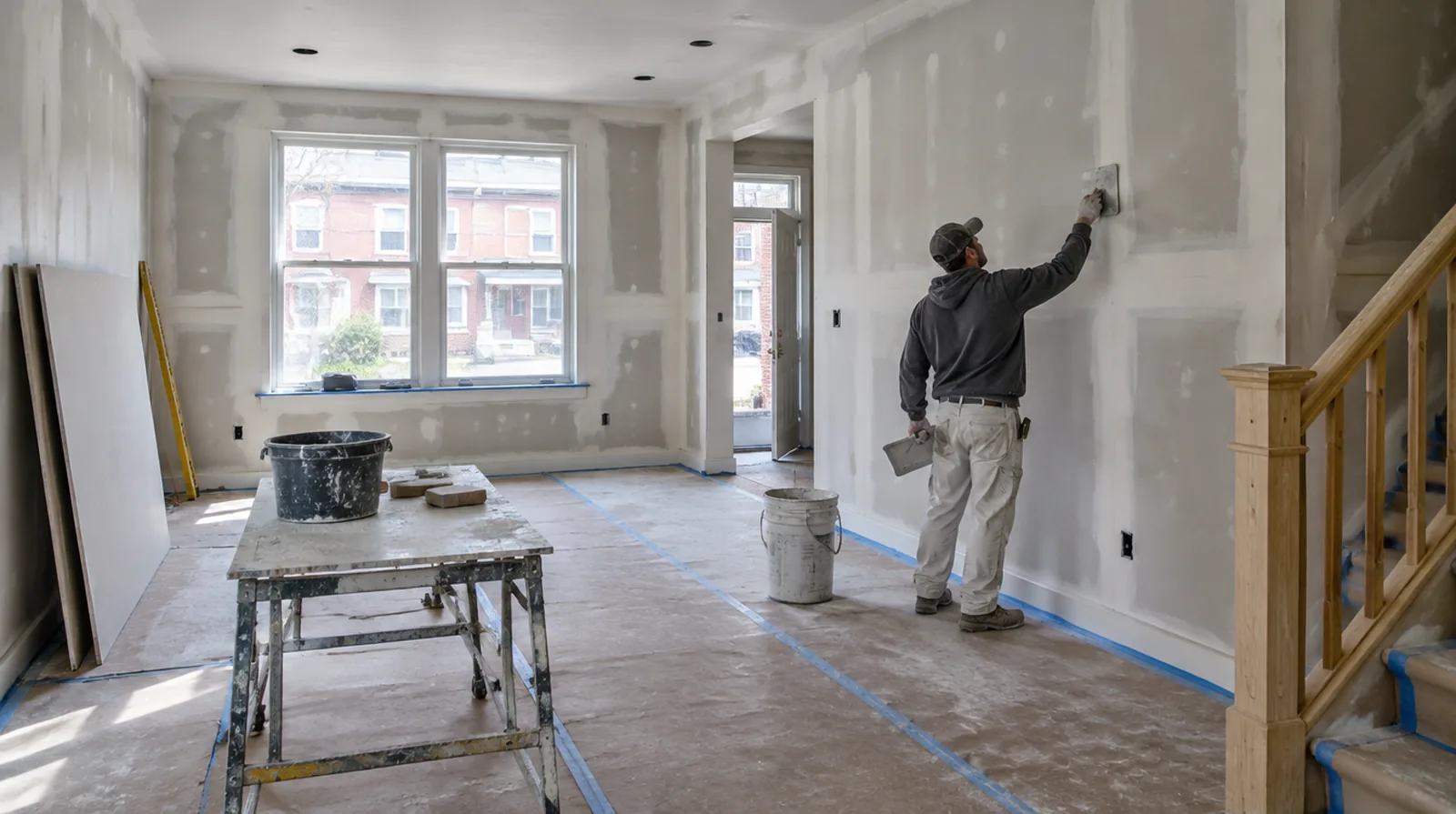
Assess the hung board
Misaligned panels or unsupported joints need attention before the finishing layers can perform properly. Fastener depth and board alignment should be checked before joint treatment begins. When building management controls access, agree delivery hours and common area protection before committing to a start or finish date.
Build the seam gradually
Make later joint coats progressively broader so the transition becomes less abrupt. Square cut sheet ends need particular care because they do not offer the recess of tapered factory edges. Where existing floors will remain, specify protective measures and review the path used by panels, equipment and finishing tools.
Choose joint materials
Joint bedding and the last surface coats do not necessarily call for identical products. Selection should reflect joint type, room conditions and the manufacturer guidance rather than convenience alone. For an older repair with no clear history, describe when the mark first appeared and whether it has changed through more than one season.
Coordinate with the painter
A primer coat sometimes makes small surface defects easier to identify than raw white compound. Establish responsibility for those final adjustments and any review after priming before the work starts. For a planned new wall mounted fixture, resolve its backing requirements while the cavity remains open instead of cutting into completed drywall later.
Agree on the visual standard
Agree how the completed wall will be viewed and decorated before choosing the finishing standard. A stated finish level helps both the drywall trade and the decorating trade work toward the same result. In a room with little free floor space, identify temporary storage for belongings and establish adequate clearance for the work before delivery.
Keep external corners straight
A corner profile only produces a straight noticeable line when it is fitted and coated correctly. Resolve distortion or damage to the bead before successive coats make correction more difficult. For a room that stays in use, set a workable boundary around construction while retaining the access people need for normal daily activities.
Inspect the whole wall
Checking only the joint lines misses transitions near corners, ceiling edges and electrical boxes. Check the finished plane under the planned lighting and from a side angle where possible. Where occupants have dust sensitivity concerns, agree containment and cleaning measures before settling the way the interior will be staged.
Consider a skim layer
Light passing across a wall can emphasize the difference between finished joints and the panel paper. A suitable skim treatment could help create a more uniform surface when the specification calls for it. For an older repair with no clear history, describe when the mark first appeared and whether it has changed through more than one season.
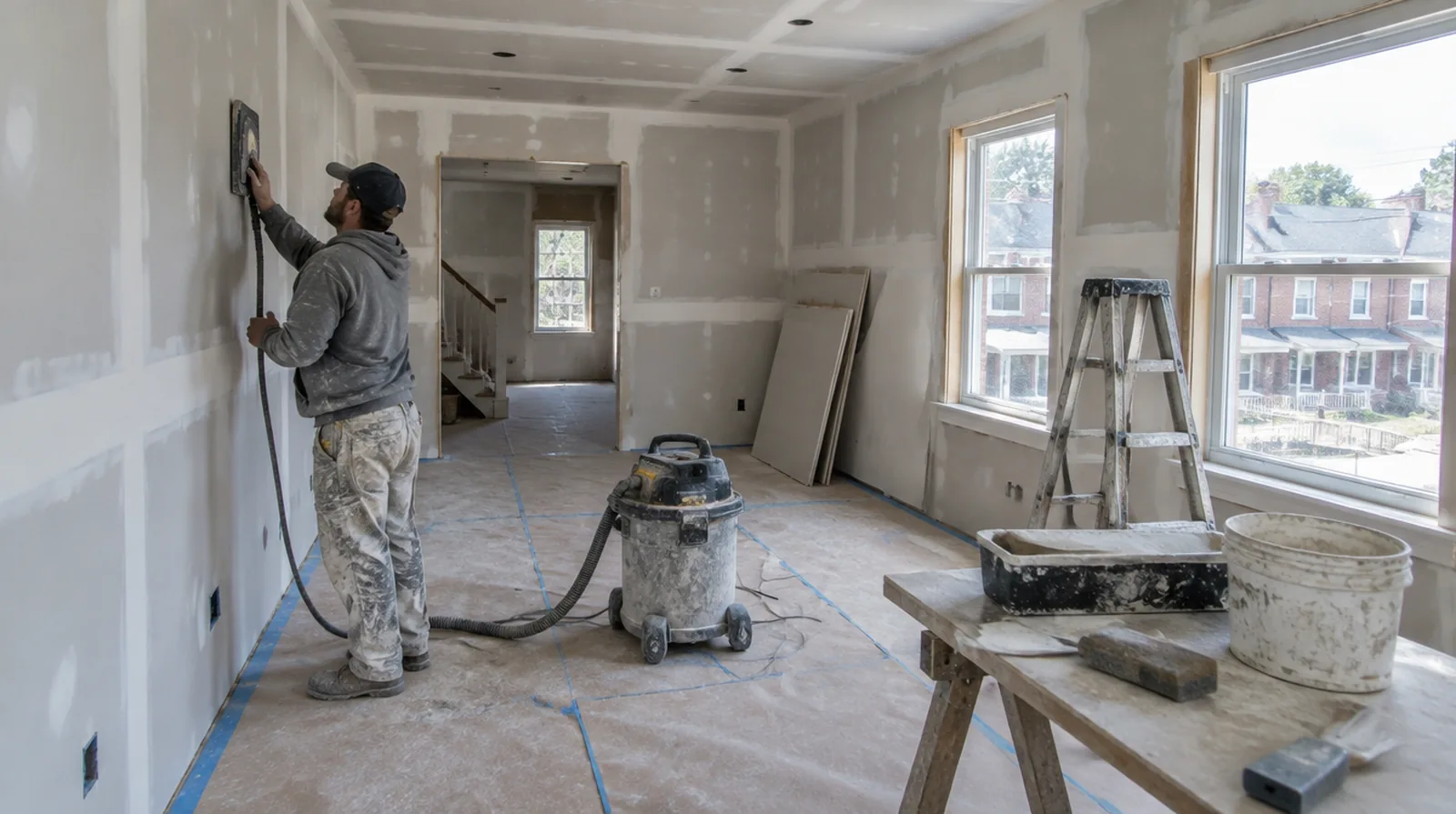
Use controlled sanding
Use sanding to refine minor imperfections instead of reshape an unnecessarily heavy joint. Dust management remains necessary even when only a limited number of seams are being finished. Where a neat final edge matters, agree whether the finish ends against existing trim or whether that trim will be removed and replaced.
Embed the tape
A continuous bedding layer supports the tape and reduces the chance of air bubbles along the seam. At an internal angle, form a clean crease and finish both sides without leaving unsupported edges. If scheduling is the main concern, separate hands on labor from drying intervals instead of treating every visit as a full day of active work.
Project context in Reading
Shared brick party walls carry noise to the neighbor, which makes agreed working hours part of a Reading project plan. Many Reading row homes still have plaster on lath, so a board patch needs to be shimmed flush with the older surface.
Scope questions before finishing
For a repair that crosses several surfaces, measure the affected planes separately so the estimate can explain where each finishing treatment starts and stops.
When a paint contractor follows the drywall work, define the surface condition being handed over and decide who handles any minor final touch ups.
If occupancy must resume on a certain day, include the later primer and paint stages in the timetable as well as drywall installation and finishing.
Where light reflects along the wall, inspect the complete plane instead of limiting the review to the edge immediately next to the repaired section.
Where the wall meets fixed furniture, clarify whether removal is included or whether the finish will terminate at the accessible edge.
When a wall has repeated defects, keep a record of earlier repair attempts so a new assessment does not simply repeat an unsuccessful approach.
If the coating stability is unclear, assess which layers are adequately bonded and which should be removed instead of simply hidden beneath new material.
When the wall surface has strong reflected light, look at the full plane instead of judging only the narrow strip immediately beside the patch.
For a surface that will receive wall covering, share the product requirements early so the finishing stage supports the planned decorative treatment.
Where occupants have dust sensitivity concerns, agree containment and cleaning measures before settling the way the room will be staged.
Where a finished perimeter is prominent, decide whether trim stays in position or is removed before agreeing how the new surface meets that edge.
When reviewing the finished work, use the agreed lighting and natural room viewpoints so the assessment reflects the intended use of the space.
Explore the Reading drywall overview for related options, or read the project planning information before arranging the next stage.
More planning details for Reading
Humid Berks County summers slow drying in a closed back bedroom, so air movement between coats helps. Original picture rail and plaster crown in older rows should be protected before any cutting begins. Painting the full wall from corner to corner hides the change between old plaster and new board more effectively.